
Te Ara Huarau: the school review process
ERO reviews and reports on English-medium state and state-integrated schools every 3-4 years. Our school reviews focus on supporting improved education outcomes for all learners.
We introduced a new approach to school reviews in 2020/21 known as Te Ara Huarau.
Te Ara Huarau is a participatory and collaborative review process where ERO works with the school to review provision, with a shared goal of supporting learner success.
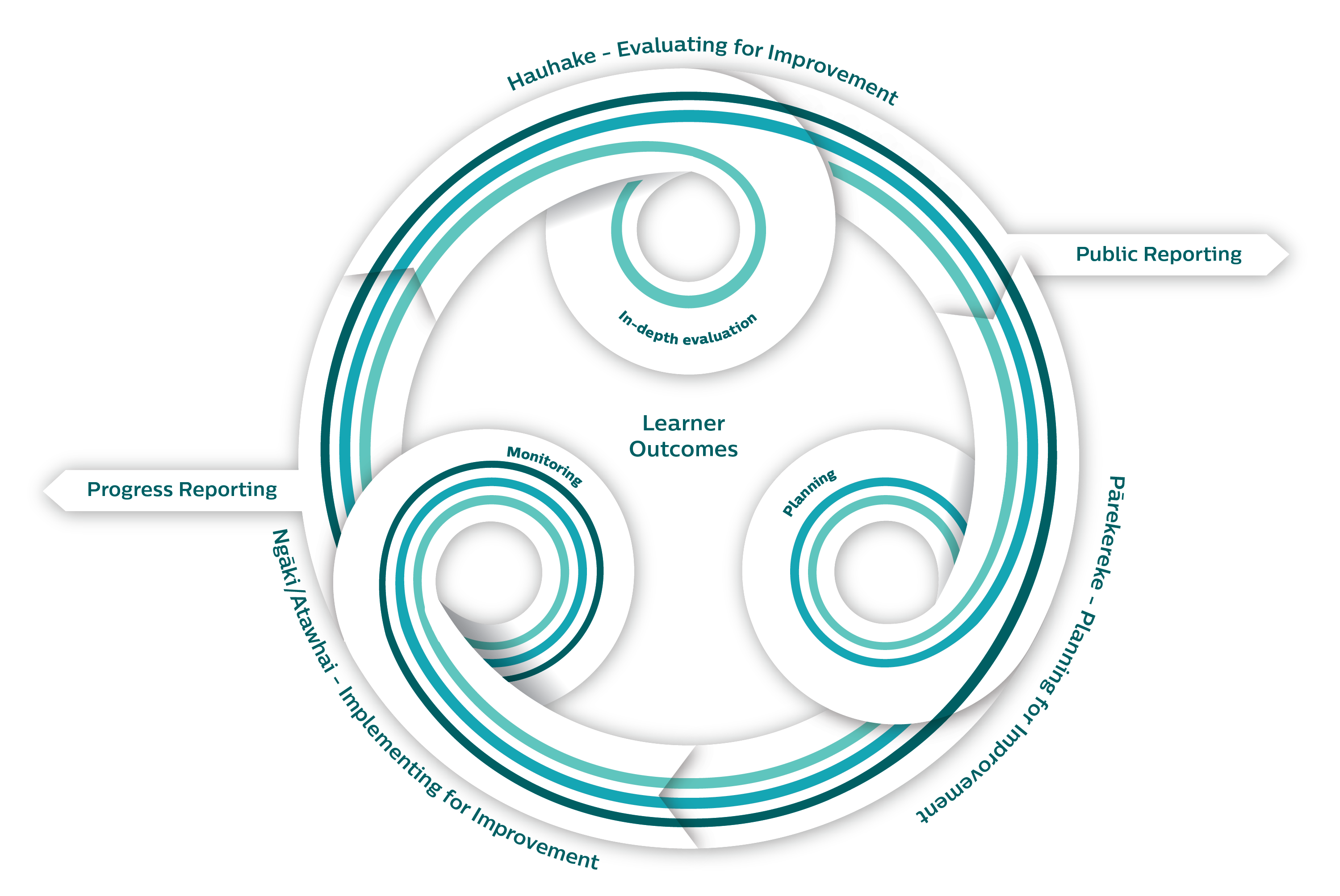
Te Ara Huarau has three phases
Hauhake | Evaluating for Improvement – every school has a Hauhake review every 3-4 years. ERO undertakes onsite visits during Hauhake. We meet with school leaders, board members, students, observe classrooms in action and verify compliance with legislative requirements. An ERO school report is written and published after this phase.
Pārekereke | Planning for Improvement – schools use ERO’s findings from the Hauhake phase and integrate the recommended next steps for improvement into their school planning.
Ngaki / Atawhai | Implementing for Improvement – if a school needs a higher level of support to bring about the necessary improvements to lift learner outcomes, ERO will regularly monitor the school’s progress and recommend further support if necessary. This includes regular online and onsite visits.
One Te Ara Huarau cycle takes place within 3-4 years.
Most schools will only engage with ERO during the Hauhake phase and have the capability to undertake Pārekereke and Ngaki/Atawhai independently from ERO.
Some schools require additional support to bring about the necessary improvements to lift learner outcomes. ERO will guide these schools through all three phases.
Hauhake: unpacking the school evaluation process
Notification of an upcoming ERO review
ERO will notify schools of an upcoming school review by email.
Before the onsite review, ERO’s lead evaluator will contact the school to explain the review process and how the school’s leaders can participate as part of the evaluation team.
The review team
For the onsite review activities, some schools will have a pair or small team of ERO evaluators visit the school. Smaller schools will have one ERO evaluator.
ERO encourages schools to have representative leaders participate as part of the evaluation team. This may include the principal, members of the senior leadership team, and members of the school board. ERO’s evaluators and the school’s evaluation team will work together.
Preparing for a school review
In the notification email, schools are asked to complete and return some specified documentation before the onsite visit.
This includes:
The School Improvement Framework (SIF)
The Board Assurance Statement (BAS)
The Hostel Assurance Statement (HAS) if the school has a hostel
Raupapa Ako Framework (RAF) if the school has rumaki/reo rua.
We also ask you to send us the following information before the onsite visit:
The school’s current Strategic Plan/Annual Plan
The most recent Statement of Variance
Analysed progress and achievement data over time
Wellbeing and engagement information, including analysed regular attendance data.
We normally request all documentation to be completed and returned to ERO at least four weeks prior to the onsite visit.
Before the onsite visit
ERO may schedule an online meeting with the school’s leader(s) to discuss the documentation that has been supplied, and the review process.
ERO’s lead evaluator will email the school with a schedule of planned evaluation activities for the onsite visit, including meetings and classroom observations.
The school is welcome to contact the lead evaluator at any time if they have questions.
What happens during the onsite visit
The ERO evaluation team will join the school evaluation team onsite to undertake a range of activities.
This includes, but is not limited to, the following:
Discussing compliance with legal obligations with the board’s presiding member
Meeting with the senior leadership to discuss attendance, progress, achievement, assessment and other data about student outcomes
Meeting with middle managers and teachers to discuss student engagement, progress, achievement
Observations of a range of classrooms, including rumaki and reo rua (if applicable)
Meeting with students
Meeting with hostel managers and students living in the school hostel (if applicable)
Meeting with international students to discuss their schooling experiences (if applicable)
Reading further documentation.
During the onsite visit, the evaluation team discuss what was observed during the classroom visits, make judgements about the school’s performance using the School Improvement Framework and Raupapa Ako Framework (where applicable), and discuss the school’s strengths and areas for improvement.
Most schools will have ERO evaluators onsite for 2-3 days.
After the onsite visit: Reporting
ERO will write a school report, based on the evidence gathered during the evaluation. This report is called the unconfirmed report.
The unconfirmed report undergoes a rigorous quality assurance process before it is sent to the school, ensuring that the report’s findings align with the evidence.
The unconfirmed report is emailed to the school principal and presiding member of the school board.
The school can send ERO any errors of fact they have noticed in the report, or, if they don’t agree with the report’s findings, schools can send an explanation and any relevant supporting documentation; and we will consider this as part of due process.
If there are no errors of fact, and the school agrees with the report’s findings, the presiding member is asked to sign a confirmation and return this to ERO.
Following this process, the report is finalised. The report is now called a confirmed report.
ERO will email a copy of the confirmed report to the school principal and presiding member of the board before it is published on ERO’s website.
We encourage schools to share the confirmed report with the school community.
More about our school reports is here.
After the review
ERO’s school reports provide schools with recommended actions for improvement designed to lift learner outcomes. ERO expects schools will implement the improvement actions outlined in the report as part of its strategic and annual planning.
If a school needs more support
If ERO determines that a school needs more support to bring about the changes necessary to lift learner success, we will recommend that the Ministry of Education provides additional support or intervention. This information is included in the school report.
Schools of serious concern
Amendments to the Education and Training Act 2020 strengthens the role of ERO in identifying schools of serious concern and the process that follows.
When ERO identifies a school may be of serious concern, the Chief Review Officer must notify the Secretary for Education and the Minister within two working days. Within 28 working days of that notification, ERO will provide a report to the Ministry confirming the serious concern status and recommending statutory intervention.
How we support schools of concern and schools of serious concern
We work more closely and frequently with schools that need it most. This includes regular progress engagements, either online or onsite, to monitor the progress the school is making.
We look for evidence that improvement actions are being implemented, that teaching and leadership practices are strengthening, and that learner outcomes such as achievement, attendance, engagement and wellbeing are improving.
Progress is not determined by one meeting or one set of data. ERO considers patterns over time and whether improvement is becoming embedded in the school’s systems, practice and monitoring.
ERO will write progress reports that outline the shifts happening.
Our commitment to equity and excellence
We are committed to supporting improved outcomes and achieving equity for all learners, particularly Māori and Pacific learners. We have an interest in what is happening for learners with additional needs. Te Tiriti o Waitangi is woven through ERO’s approach.
Through our participatory Te Ara Huarau review model, ERO seeks to understand the unique context of each school and how it serves its students, parents, whānau and community,
Our differentiated model allows us to place our resource and support where it is needed most.
We’re committed to continuing to work with the sector.
Thank you for your support
At ERO, we know what great schools do – and we will support every school to be a great school.
Ko te tamaiti te pūtake o te kaupapa
The child - the heart of the matter