
Reporting | Education Review Office
Formatted
ERO’s school reports
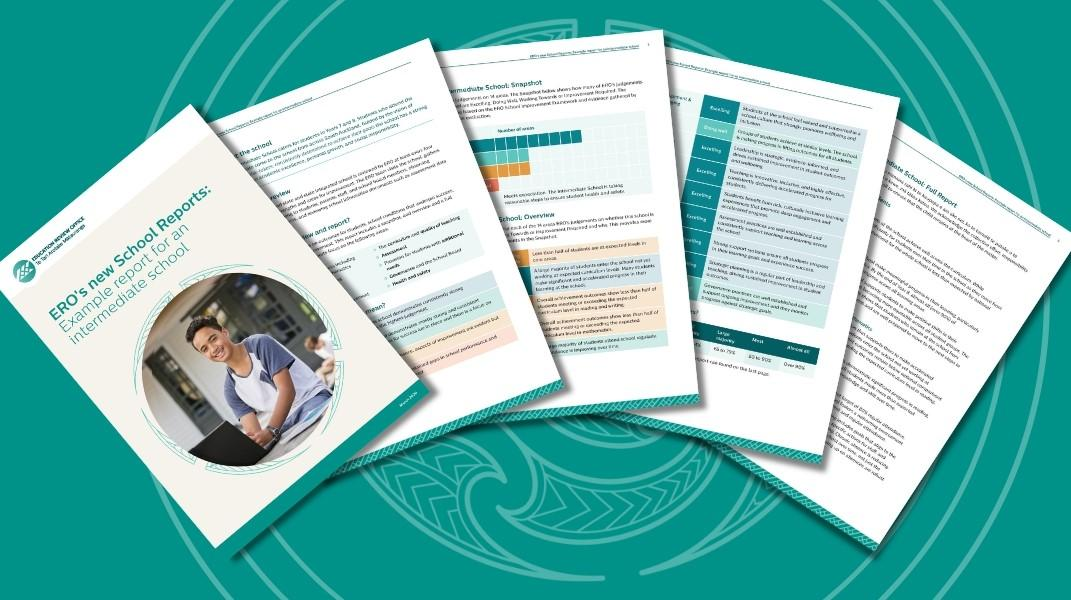
ERO’s school reports are published on ERO’s website following a school review. This happens every three to four years.
School reports provide parents and whānau, the community, and school leaders with information about how a school is performing and supporting students in their learning. School reports show where improvement is needed, in the key areas that matter most for students and their education.
ERO updated its school reports in 2026. Some reports on our website will be in the older format.
You can search for a school’s report here.
Our new school reports
Our new school reports are easier for parents and whānau to understand what’s working well at their child's school, and what needs improvement.
Schools will find our new reports are more clear on next steps, with detailed actions for school leaders and boards. These new reports will be useful for your school's planning - focusing on the key things that will make the most difference for your students.
The new school report has three parts:
A visual snapshot
An overview table of all of the judgements
A full report with more detail.
The report provides information that is useful for parents and whānau, including:
An easy-to-understand snapshot and an overview showing 14 judgements about student success and wellbeing, including attendance, assessment, achievement, and progress (the report will have16 judgements if the school has rumaki / reo rua)
A summary about the quality of teaching and learning through the provision of te reo Māori in rumaki (full immersion) and reo rua (bilingual) classrooms, where appropriate
A summary of the school board’s attestation to meeting legislative and regulatory requirements
Reporting on the provision in School Hostels and for International Students, where appropriate
A two-page explainer about the new reports for parents and whānau can be found below.
The report provides information that is useful for school leaders, including:
Clear next steps for improvement - these are the areas that the school needs to focus on improving, to lift student outcomes
Recommendations for additional support or intervention, if the school is of concern
A two-page explainer about the new reports for schools and boards can be found below.
ERO school report explainers
Download all (ZIP | 0.63 MB)Examples of our school report format
Download all (ZIP | 3.08 MB)Guide to Schools: for parents and whānau
This guide is for parents and whānau. It talks about what really matters in schools and the important role you play in your child’s education. We explain how ERO reports can be useful, give tips for asking questions, share options for raising concerns, and link you to other useful resources. You can read the guide here.
Q&A about our new school reports
Is Te Ara Huarau changing?
No. We continue to use Te Ara Huarau as our approach to school reviews. Te Ara Huarau focuses on working alongside schools to understand context and support continuous improvement. You can find more about Te Ara Huarau here: Te Ara Huarau: the school review process | Education Review Office
How is ERO making judgements about schools for the report?
The judgements presented in the reports align with the School Improvement Framework (SIF). We work through the SIF with you during the review process to arrive at the judgement level.
How is ERO reporting attendance?
As attendance is one of the Government’s key education targets, ERO will report on this measure for every school. We are reporting on this as an outcome measure – so that means we are making judgements about the level of regular attendance in all schools and then we are explaining context and what the school is doing about raising attendance levels. This ensures that outcome judgements in reports across the country are very consistent and reliable.
How do reports show each school’s unique context?
Our evaluators take the time to understand each school’s unique context and the story behind the numbers.
Evaluators consider each school’s context, including factors beyond its direct control. This helps them interpret evidence, reach judgements, and describe findings fairly.
For example, where attendance is lower, reports describe what the school is doing to improve engagement. If a school is making strong progress from a low starting point, this will be recognised in the report.
How do reports show the positive progress my school is making?
Reports celebrate what schools are doing well and acknowledge the good progress schools are making for their students. Progress over time is a key part of understanding whether a school’s actions are making a difference.
Will I be able to respond to the report before it is confirmed?
We have not changed the confirmation process for reports. School boards review and respond to unconfirmed reports, and can provide feedback or further evidence. All feedback is carefully considered before the report is confirmed as final.
Do reports provide a single grade for schools?
No. We do not provide a single overall grade for schools. Schools have unique contexts, strengths, and challenges, and cannot be meaningfully or accurately ranked.
The reports present multiple judgements across different areas of practice, aligned to the School Improvement Framework.
How is ERO using artificial intelligence (AI) for reporting?
ERO uses AI-assisted drafting to support the development of initial school report narratives from evaluation evidence. All synthesis, analysis, judgements, findings, and final report content remain fully human-led and are the responsibility of ERO staff, with all content reviewed, quality assured, and approved prior to publication.
ERO uses AI under clear rules and guidance to make sure it is used safely, ethically, and in line with New Zealand law and Public Service AI Frameworks.
Where can I read some of the new reports?
You will find reports here. Ensure you have sorted by “most recent at top”.
Schools reviewed in Term 1 will have the older style of report published.
Progress reports
Some schools need more support to bring about the improvements required to lift learner success.
Where we identify that a school needs additional help, we work closely with the Ministry of Education to ensure that the right support is provided in a timely way. To make sure that this support is making a difference, we will monitor the school’s progress against the improvement actions outlined in the school’s report, with regular check-ins and progress visits.
Progress reports are written following a progress visit. This report provides information about the progress the school is making towards the improvement actions set out in the school’s most recent ERO report.
Progress reports are provided to the school, and are not published on our website.
How ERO uses AI
ERO uses artificial intelligence (AI) under clear rules and guidance to make sure it is used safely, ethically, and in line with New Zealand law and Public Service AI Frameworks.
These safeguards mean AI is only used to support our work. All analysis, judgement and decisions remain the responsibility of ERO staff, with clear accountability, governance and oversight in place.
We are committed to being open about how we use AI, including where and when it is used.
The statement below explains how these protections work in practice when AI is used to help draft school reports.
ERO uses AI-assisted drafting to support the development of initial school report narratives from evaluation evidence. All synthesis, analysis, judgements, findings, and final report content remain fully human-led and are the responsibility of ERO staff, with all content reviewed, quality assured, and approved prior to publication.
Information about older style ERO reports
Our reports changed in early 2026. Older style ERO reports look different and use some specific language. This guide is designed to help parents and whānau to better understand our older-style school reports and navigate the key findings.
It explains the judgement terms we use in our older school reports, what we looked for as part of those reviews, as well as definitions for the language used in those reports.
-
A Guide To ERO’S School Reports For Reports Published Before April 2026 PDF | 0.40 MBDownload